
When the truck can’t reach the door: how a shuttle move works in the Hawkesbury
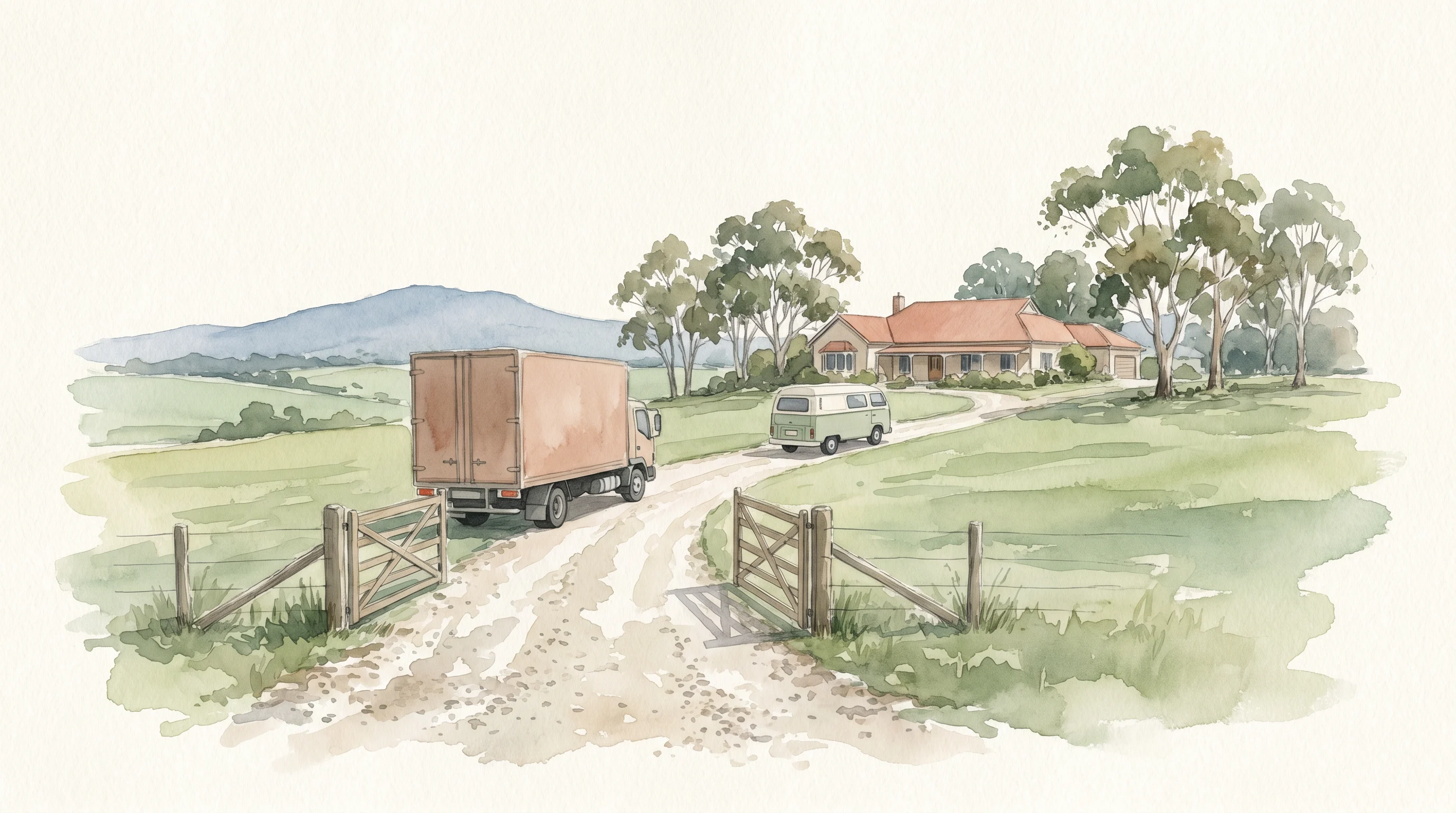
If you’ve only ever moved house in the suburbs, the idea that a removal truck might not be able to reach your front door can sound odd. Out in the Hawkesbury, it’s one of the first things we check — and for good reason.
This is a rural valley. Across the area roughly 87 in every 100 homes are standalone houses rather than units, and density runs near 25 people per square kilometre, about a twentieth of greater Sydney’s. That translates into long driveways, gravel and dirt instead of concrete, real gradients up toward the ridge, farm gates, and low river-flat ground that turns soft after rain. A 12-to-14-metre pantech — the truck that makes a suburban move efficient — needs firm ground, swing room and a turning circle that a lot of Hawkesbury properties simply don’t offer.
Why the big truck struggles out here
A few things, often together, make the difference:
- Length and surface. A long gravel or dirt drive can be too soft or too loose for a heavy, fully-loaded truck — especially after rain, when a verge that looked fine on the quote becomes a bog by move day.
- Gradient. A steep drive that a car climbs without thinking is a different story for a truck carrying a household. Up around Kurrajong and the Grose Vale lanes, this is the norm rather than the exception.
- Gates and width. A standard farm gate or a tree-lined entry can be narrower than a pantech needs, and you don’t want to find that out with the truck nose-in.
- Nowhere to turn. If a large truck can get in but can’t turn around, the only way out is reversing a long, blind drive — which is slow and risky.
How a shuttle move solves it
The answer is the same one removalists have always used for difficult access: a shuttle. We park the big truck where it can stand safely and legally — a firm section of the drive, a level verge, the road if that’s the sensible spot — and run a smaller, surefooted truck between there and the house. Your furniture still goes into the one truck for the journey; the shuttle just handles the first and last stretch the big truck can’t.
Done as an afterthought, a shuttle is a scramble. Planned ahead, it’s a smooth, costed part of the day. That’s the whole point of sorting access before move day rather than on it.
What it means for your quote
Two honest things. First, a shuttle adds a bit of handling, so it costs a little more than a straight direct load — we’ll tell you that up front, not on the day. Second, and more importantly, planning it removes the genuinely expensive risk: a truck stuck on a wet drive, a half-day lost, and a stressed-out moving day.
The quickest way to know where you stand is our access planner. Describe your driveway, gate and the ground, and it’ll tell you whether you’re looking at a direct load or a shuttle — and let you print a prep sheet to have ready. When you’re set, get a quote and we’ll confirm it from your addresses and a photo or two.
Common questions
What is a shuttle move?
Transferring your load between the full-size removal truck — parked where it can safely stand — and a smaller, more manoeuvrable vehicle that does the runs to and from the house. It’s used whenever the property’s own access can’t take the big truck.
Does a shuttle move cost a lot more?
It adds some handling, so it’s a little more than a straight direct load — but planned in advance it’s a known, costed step, not a blowout. The expensive version is the one nobody planned for: a truck bogged on a wet drive that loses you half a day.
How do I know if my Hawkesbury property needs a shuttle?
Use our access planner — describe your driveway, gate and the ground and it gives an honest read in a minute. Or send a photo of the drive with your quote and we’ll tell you.
Planning a move?
Get a free, no-obligation quote and we'll plan the access at both ends with you.
Get a quote